
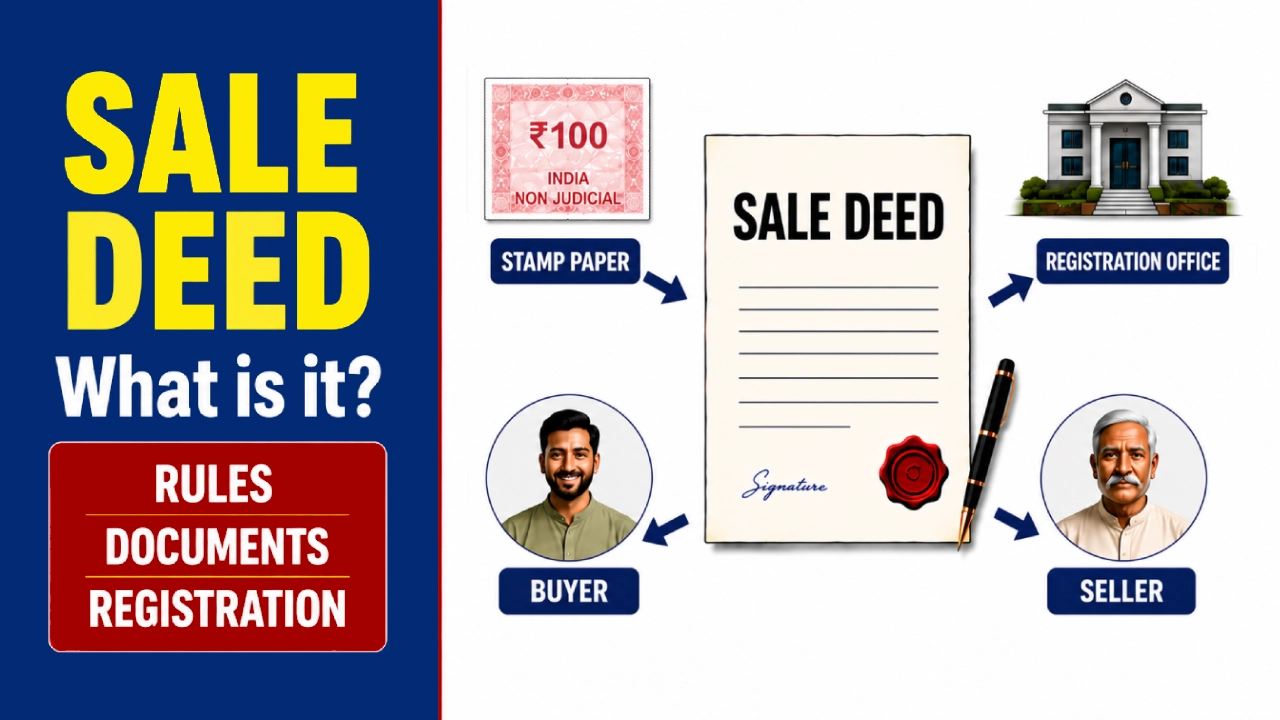
Whenever someone buys a plot of land, a house, or a shop, a Sale Deed is created to transfer ownership of the property from the seller to the buyer. In everyday language, people often simply call it “registry”. In official registration records, it is known as a conveyance deed or contract of sale. This document is one of the most important pieces of evidence showing that you own the property.
Let’s understand in simple terms what a Sale Deed is, how the registration process works, and what things you must check before buying a property.
Is a Sale Deed and Registry the Same Thing?
People often use the terms “Sale Deed” and “Registry” interchangeably, but there is a slight legal difference. The Sale Deed is the actual physical document that contains all the terms, conditions, sale price, and property boundaries of the deal. On the other hand, Registry (Property Registration) is the official government process of submitting that deed to the Sub-Registrar Office to officially register it with the government. In short, the Sale Deed is the document, and the Registry is the legal process that officially records the Sale Deed with the government.
What is a Sale Deed?
A Sale Deed is a legal document that transfers property ownership from the seller to the buyer permanently. Once both parties sign this document and it is officially registered at the local Sub-Registrar’s Office (SRO), the buyer becomes the legal owner of the property, subject to local laws and any existing legal disputes.
Important Things That Must Be Written in a Sale Deed
To ensure your document is legally valid and to avoid ownership disputes in the future, a properly drafted Sale Deed must clearly state these details:
- Details of the Buyer and Seller: Full names, parent or spouse’s names, permanent addresses, and government-issued ID proofs of both the seller and the buyer.
- Previous Ownership History (Chain of Title): A clear description of how the seller got ownership of the property. This is often called the “Chain Deed” or “Link Kewala”. If the seller bought it from someone else, the registration number and date of that old deed must be mentioned.
- Property Details and Boundaries (Chauhaddi): Clear details about the property, including the survey number, plot or khasra number, total area, and what lies in all four directions (North, South, East, West) like neighboring plots or roads.
- Payment Details: The exact total price agreed for the property. It must include clear details of any advance money (token amount) and the final payment, along with cheque numbers, Demand Draft (DD) details, or online bank transaction IDs.
- Property Possession and Witnesses: The exact date when the physical possession of the property will be handed over to the buyer. The document must be witnessed by at least two adults, as required under local registration procedures.
Note that this document is known by different names in different parts of India. It is commonly called Bainama in Uttar Pradesh, Kewala in parts of Bihar and Jharkhand, and is officially referred to as a Sale Deed or Vikray Vilekh in official registration documents. While the names are different, the purpose is exactly the same: legally transferring ownership of the property.
Documents Required for Sale Deed Registration
To register your Sale Deed smoothly at the local office, keep these documents ready beforehand:
- The original old title deeds of the property (old sale deeds, allotment letters, etc.).
- A certified, updated copy of land records (like Khatauni, Jamabandi, or Mutation records) for the current year.
- Valid identity and address proofs (like Aadhaar card, PAN card, or Voter ID) of both buyer and seller.
- An official valuation certificate showing the current Circle Rate of the area, issued by the Revenue Department.
- E-Stamp Papers bought according to the calculated stamp duty value, along with the registration fee receipt.
- Recent passport-sized photos of the buyer and seller, along with ID proofs of two adult witnesses.
Things to Check Before Signing a Sale Deed (Checklist)
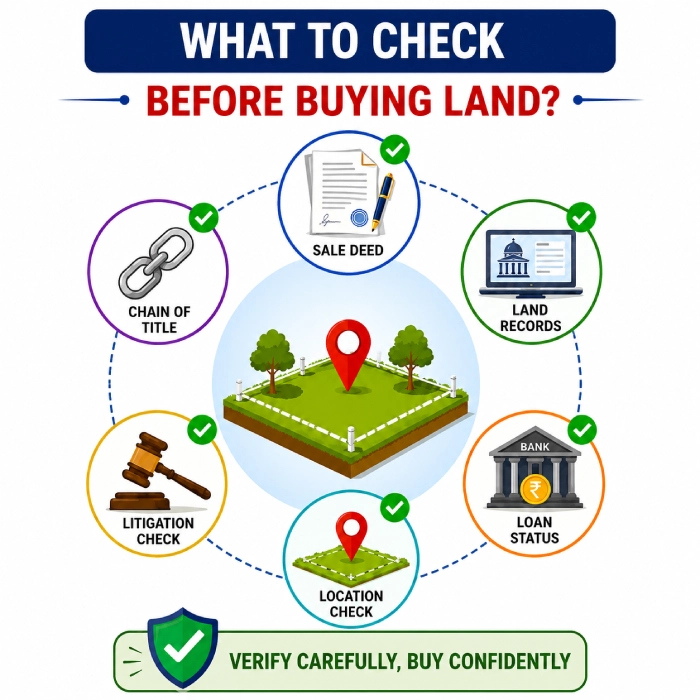
Do not sign a Sale Deed blindly. Make sure you complete this safety checklist before final registration:
- Verify Ownership: Cross-check the seller’s name with official online government land records to confirm they are the actual owner.
- Check Encumbrance Certificate (EC): Get an EC from the sub-registrar office for the last 15 to 30 years to ensure the property has no unpaid loans or legal disputes.
- Verify Property Tax Receipts: Check old tax receipts to ensure the seller has cleared all municipal or property tax dues.
- Confirm Mutation Records: Make sure the property was properly mutated (Dakhil-Kharij) in the seller’s name in the government revenue registers.
- Check Approved Layout Plan: If you are buying a flat or a plot in a colony, verify that the building layout plan is approved by the local development authority.
- Confirm No Pending Litigation: Check with local courts or legal experts to ensure there is no ongoing family dispute or court case regarding the property.
Sale Deed vs. Agreement to Sell: Understanding the Difference
People often mix up ‘Agreement to Sell’ and ‘Sale Deed’. Thinking that an agreement is the final ownership document can lead to big problems later.
| Basis of Comparison | Agreement to Sell | Sale Deed |
| Ownership Title | The seller remains the legal owner even after signing this agreement. Ownership does not transfer immediately. | Ownership transfers to the buyer as soon as the document is officially registered. |
| Stamp Duty Expenses | Can be made on minor stamp paper worth ₹100, ₹500, or ₹1,000. The cost is very low. | Requires a significant stamp duty payment (around 4% to 7%) based on the circle rate or transaction price. |
| Payment | The buyer usually pays only an advance or token money (like 10% or 20% of the total price). | The buyer must make full and final payment to the seller before or during execution. |
| Bank Loans & Resale | You cannot get a bank loan using this document, and you cannot sell the property to anyone else. | You can easily get a bank loan based on this document and can sell the property in the future. |
| Risk of Fraud | Higher risk. A dishonest owner might try to make multiple agreements for the same property with different people. | Once registered, the transaction becomes part of the official registration records, making a fraudulent resale much more difficult. |
| The Next Step | The next step after this agreement is executing and registering the final Sale Deed. | The immediate step after a Sale Deed is applying for land Mutation (Dakhil-Kharij) in revenue records. |
What is the Next Step After Sale Deed Registration?
Getting your registered Sale Deed copy from the office does not complete your work. Immediately after registration, you must apply for Land Mutation (Dakhil-Kharij) in the local revenue office or court. Mutation is the process where the government removes the old owner’s name from its revenue registers and adds your name as the new owner and taxpayer. Some banks may refuse loans or future buyers might reject the property until the mutation process is completed. Therefore, make sure to check and update your land mutation status online.
Should You Buy Land Safely Just by Looking at a Sale Deed?
No. Buying property based only on a quick look at a Sale Deed is risky. A registered Sale Deed is one of the strongest pieces of evidence of ownership, although ownership can still be challenged in court in certain situations like fraud or legal disputes. You must check that the person selling the property actually owns it by matching details with online land records, state Bhulekh websites, and mutation logs.
Additionally, look through older link deeds (Chain Deeds) to make sure there are no active bank loans, court disputes, or legal blockages on the land. Make the final payment only after verifying that all property records and ownership details are consistent.
If you are buying property belonging to a joint family, verify if a formal, registered Partition Deed (Ansh Nirdharan) has been created. This helps avoid unexpected disputes with other family members later on.
How to Get a ‘Certified Copy’ if the Original Sale Deed is Lost or Damaged
If your original Sale Deed is lost, stolen, or damaged, do not worry. First, file a report (FIR or Missing Report) at your local police station. In some locations, you might also need to publish a small notice in a newspaper. After this, visit the same Sub-Registrar Office where your property was registered. By submitting an application form and paying the government fee, you can get an official Certified Copy of your deed. Legally, this certified copy has the same value as the original document in a court of law.
Can a Registered Sale Deed Be Cancelled?
Legally, once a Sale Deed is registered before a Sub-Registrar, it cannot be cancelled easily. No single party can cancel it on their own, and the registration office cannot cancel it either. A Sale Deed can only be cancelled through an official order from a Civil Court. The court will only do this if it is proven that the registration was done through fraud, fake documents, cheating a minor, or forcing someone by threats.
Time Limit for Cancellation Cases: Under the Limitation Act of 1963, there is a strict time window to challenge a fake or fraudulent deed in court. The affected person must file a case for deed cancellation in a civil court within 3 years from the date they find out about the fraud. After these 3 years pass, courts generally do not accept the case.
Stamp Duty and Registration Fees: Cost Breakdown
When registering a property, you have to pay taxes to the government, which are called Stamp Duty and Registration Fees. These rates change from state to state and are calculated based on the official government price of the land, known as the Circle Rate. Generally, stamp duty rates are between 4% to 7% of the total property value, and registration fees are around 1%. Many states give a special 1% to 2% discount on stamp duty if the property is registered in a woman’s name to encourage female ownership.
Is a ‘Conditional Sale Deed’ Valid?
A Conditional Sale Deed is an agreement where a specific rule or condition is added (for example, stating that possession will only be given after a bank cheque clears). Legally, these conditions can be written if both buyer and seller agree. However, courts have generally held that ownership is transferred according to the terms of the registered document and local laws. To stay completely safe from future court cases, legal experts always advise keeping your Sale Deed absolute and unconditional.
Frequently Asked Questions (FAQ)
Can someone become the real owner of a property without a registered Sale Deed?
No. Under the Transfer of Property Act, buying any immovable property (like land or a house) worth more than ₹100 requires a registered deed signed at the Sub-Registrar Office. Without registration, ownership claims are not valid in the eyes of the law.
How long does land mutation take after Sale Deed registration?
You should apply for mutation immediately after registration. The exact processing time varies by state and local authority, but it is typically completed within 35 to 45 days if there are no disputes or objections on the property.
What happens if the seller refuses to sell the land after taking advance token money?
The buyer has full legal rights to file a case for Specific Performance in a Civil Court. The court can order the seller to execute the Sale Deed as agreed, or order them to return your full money along with interest.
How can we fix spelling mistakes or wrong bank details written in a registered Sale Deed?
If you find typing errors, wrong cheque numbers, or mistakes after registration, you can fix them by creating a Rectification Deed (Correction Deed). Both buyer and seller must go back to the Sub-Registrar Office to sign this new correction paper.
Does an advance token money agreement have a valid time limit?
Yes. Both parties decide on a time limit (like 3 months or 6 months) to pay the remaining money and register the deed. If no time limit is written in the agreement, the default legal limit under the law is 3 years to complete the deal.
Are Sale Deed and Property Registration the exact same thing?
People use them interchangeably, but they are a bit different. The Sale Deed is the physical legal document that contains all the rules, pricing, and boundaries. Property Registration is the actual government process of submitting and locking that document at the Sub-Registrar Office.
Who keeps the original Sale Deed after registration?
The original registered Sale Deed is usually returned to the buyer after registration. If the property is financed through a bank loan, the bank may keep the original document until the loan is repaid.
Conclusion
A registered Sale Deed is one of the most important legal documents in a property transaction. Before registering any property, it is highly recommended to have a good property lawyer read every clause to ensure everything is safe. Always make your payments through safe bank modes so that clear payment details can be added directly inside the document. Spending a little time checking everything now will keep your hard-earned house or plot safe for life.
Disclaimer: Property laws and registration procedures may vary across Indian states. Always verify the latest rules with your local Sub-Registrar Office or consult a qualified property lawyer before completing a transaction.

Neha Yadav is an engineer and researcher specializing in Indian land records, property documentation, and government land procedures.
At BhumiGyan, she creates well-researched, easy-to-understand guides on topics such as Bhulekh, Jamabandi, property registration, Sale Deeds, Mutation, and other legal property processes, helping readers make informed property decisions with confidence.