
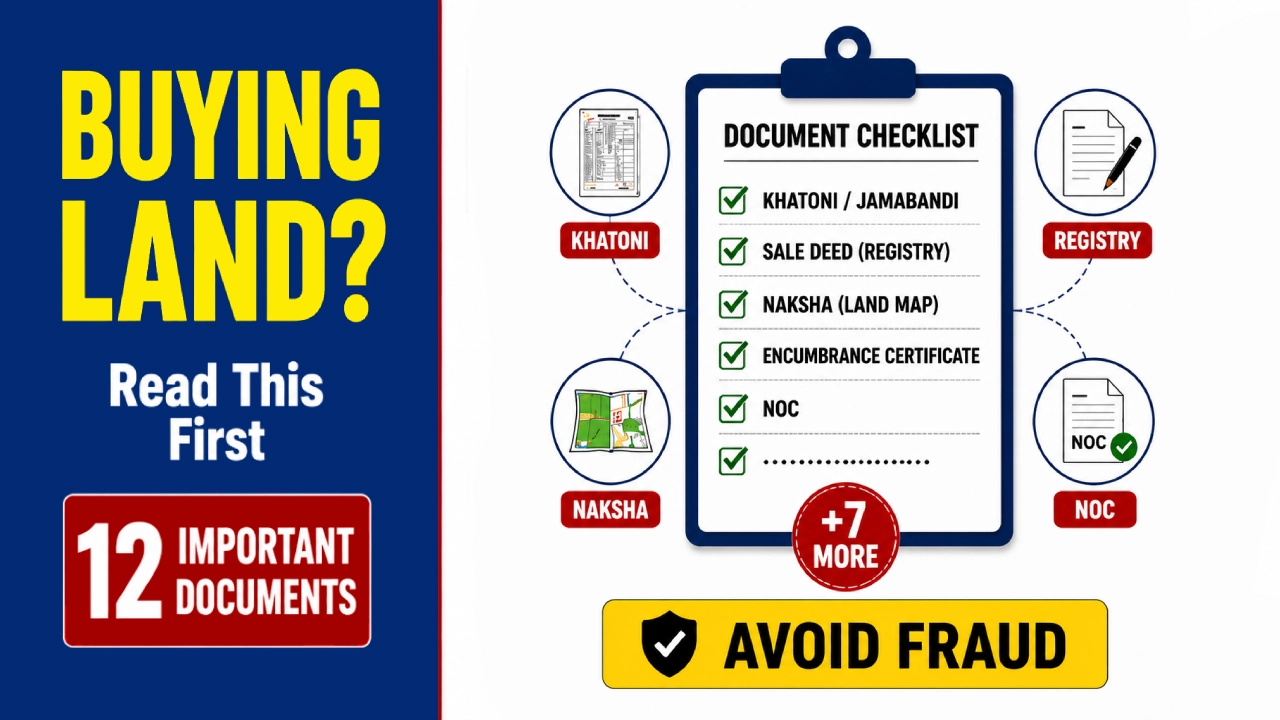
Buying land, a house, or a plot is a significant financial decision. Before making the purchase, it is essential to verify the property’s ownership, legal status, and government records. Missing even a single important document can lead to ownership disputes, unpaid loans, registration problems, or delays in future resale.
In this guide, you’ll learn about the 12 essential documents you should check before buying any property in India. From the Sale Deed, Khatauni or Jamabandi, and Mutation Certificate to the Encumbrance Certificate, approved land map, and other important legal records, this checklist will help you verify the property’s ownership and reduce the risk of fraud or future legal issues.
In Short: Before buying land, always verify the original Sale Deed, current Khatauni or Jamabandi records, Mutation, Encumbrance Certificate, approved land map, and ownership documents. Checking these records helps protect you from fraud, legal disputes, and financial losses.
The Complete Step-by-Step Legal Process of Buying Land
When buying property, a golden legal rule applies: “Buyer Beware” (Caveat Emptor). This means the law expects the buyer to thoroughly check all land facts and documents before paying. Here is how a clean, safe land deal works in simple steps:
- Get a Title Search Report from a Lawyer: Once you like a property, take photocopies of all its old papers to an experienced civil or property lawyer. The lawyer will trace the records back 13 to 30 years at the government registry office and create a “Title Search Report” to confirm the land has a clear and clean ownership history.
- Sign a Registered Agreement to Sell (Bayanapatra): If the title report comes back clean, sign a formal agreement to sell on stamp paper with the seller. This document must clearly state the final agreed price, the advance token money (Bayana), and the exact time limit given to complete the final registry. Always pay this advance via cheque or online bank transfer to keep a permanent proof of payment.
- Pay Stamp Duty and Government Fees: When your registration date is set, your state government’s local Circle Rate determines the minimum value of your land. Stamp duty (around 4% to 7%) and registration fees (around 1%) are calculated based on this value. This amount can vary by state and is often discounted if the property is registered in a woman’s name. It must be paid online or via a bank chalan.
- Register the Sale Deed at the Sub-Registrar Office (Tehsil): On registration day, the buyer, the seller, and two independent adult witnesses must go to the local office with their valid government identity cards and address proofs. Signatures, thumb impressions, and digital biometric photos are taken directly in front of the Sub-Registrar to officially register your Sale Deed (Bainama).
- Apply for Land Mutation (Dakhil-Kharij): Immediately after receiving your registered Sale Deed copy, file a mutation application with your local revenue official (Patwari, Lekhpal, or circle office). This final step officially removes the old seller’s name from government revenue records and registers your name as the new owner and taxpayer.
Title Search by Property Lawyer
Agreement to Sell
Stamp Duty Payment
Sale Deed Registration
Land Mutation (Dakhil-Kharij)
Please note that many first-time buyers mistake Registry and Mutation for the same thing, but they are completely different legal processes. To understand why your title is incomplete without both, read our detailed guide: “What is the Difference Between Registry and Mutation?”
12 Essential Documents to Check Before Buying Land
To keep your hard-earned money completely safe and avoid running around courts for years, make sure you double-check these 12 critical government documents before closing any deal:
1. Original Sale Deed (Asli Bainama)
The seller must show you the physical, original copy of their registered Sale Deed. Look closely for the official government stamps and signatures from the Sub-Registrar Office. Red Flag: Never sign a deal or hand over a large sum of money just by looking at a photocopy or a scanned PDF. Scammers often use forged or duplicate copies to sell the same plot to multiple buyers.
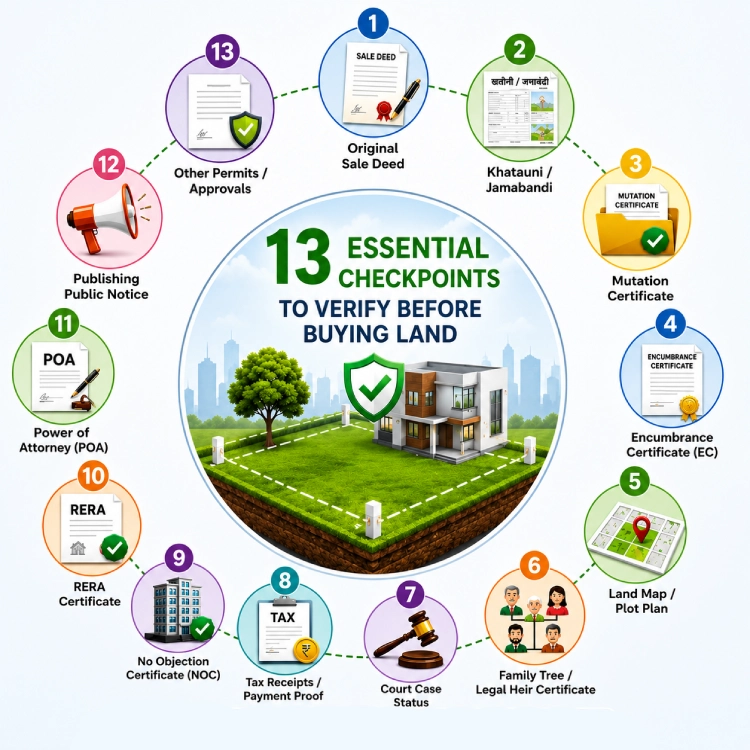
2. Current Khatauni or Jamabandi (Live ROR Records)
This is the core land account document managed by the state’s revenue department, which you can easily pull up online on state Bhulekh portals. It lists the exact current legal owner of the land. Make sure you fetch a fresh copy right before your deal to confirm that the person standing in front of you is still the registered owner in government records.
Note that this document goes by different local names depending on your state. It is called Khatauni in Uttar Pradesh and Uttarakhand, Jamabandi in Bihar, Jharkhand, Rajasthan, Punjab, and Haryana, and is broadly known as the Record of Rights (RoR). If you are confused about how these records operate, read our helpful breakdown: “What is the Difference Between Khatauni and Jamabandi?“
3. Mutation Certificate (Dakhil-Kharij)
A seller might show you a Sale Deed from when they bought the land, but you must ask for their Mutation Certificate too. This document proves that the government successfully updated its revenue ledgers after that past purchase. If the property was never mutated in the seller’s name, they do not possess a clean legal title to pass on to you.
4. Encumbrance Certificate (EC)
An Encumbrance Certificate (EC) acts as a clear record showing whether the property has any pending legal liabilities or unpaid bank loans. You can apply for this at the sub-registrar office or your state’s online registration portal. Search for records covering the last 15 to 30 years. If the land was ever mortgaged for a farm loan (like a Kisan Credit Card – KCC) or a commercial loan, it will show up right here.
5. Authorized Land Map (Shajra or Aks Shajra)
Some dishonest property dealers often show a beautiful, clean plot on-site but trick you by registering a different, lower-value piece of land inside the paperwork. To avoid this type of fraud, ask for the official government-certified map from the local Lekhpal or Patwari. Take the map to the spot and check that the plot number (Khasra) and the physical boundaries match your site layout perfectly.
6. Family Tree and Succession Papers (Vanshavali)
If the seller got the property as an inheritance after the death of their father or grandfather, always demand an official family tree certificate or succession paper. This reveals exactly how many legal heirs (including sisters and brothers) share a claim on that ancestral land. If you buy the property without the written consent or signatures of all legal co-owners, your registry can easily be cancelled by a court later on.
To safely navigate inheritance properties, it is highly recommended to read our detailed legal breakdowns: “Who Inherits a Property If an Owner Dies Without a Will?” and “What Are a Daughter’s Legal Rights in a Father’s Property?”
7. Approved Layout Plan
If you are buying a residential plot inside a newly developed private colony or township, this document is non-negotiable. Always check if the layout plan has been officially approved by the local city development authority (like LDA, JDA, BDA) or the town planning municipal corporation. If you invest in an unapproved, illegal colony, you risk facing local demolition drives later on.
8. RERA Registration Certificate
Under Indian law, every large builder or commercial township project must be registered on the state’s RERA (Real Estate Regulatory Authority) portal. Always ask the developer for their unique RERA registration number and cross-verify it directly on the state’s official website. This confirms that the developer has all the valid legal clearances to sell those plots.
9. Land Conversion Certificate (NA Order)
By law, agricultural land in India cannot be used to construct houses or commercial shops without formal government permission. Ask the seller if they have obtained an official land conversion order (commonly known as a Non-Agricultural or NA Certificate, processed under Section 143 or 80 of regional revenue codes). Buying agricultural land for residential purposes without this conversion can invite legal blocks.
10. Registered Power of Attorney (POA)
If the actual legal owner of the land is unable to attend the registration and has appointed a dealer, relative, or agent to handle the sale, they use a Power of Attorney (POA). Check whether this POA is formally registered at a Sub-Registrar Office. More importantly, verify that the original owner who signed the POA is alive on the day of your final registry, as a POA generally becomes invalid upon the death of the owner.
11. Recent Property Tax Receipts (Lagaan Parchi)
Before closing your deal, make sure the property is free from old government tax dues. Ask the seller to provide official tax receipts or land revenue slips (Lagaan receipts) for the past 3 consecutive years. This serves as clear proof that all municipal and state dues are settled and acts as a secondary verification of the owner’s identity.
12. Verification of Pending Litigations (No Court Case)
Many unsuspecting buyers end up with properties that are trapped in decades-long court cases between family members or neighbors. To protect your investment, work with a local advocate to search the official e-Courts portal using the plot’s Khasra number, the seller’s full legal name, or the available property details to ensure no civil court disputes are currently pending on the asset.
Additional Safety Tip: Publishing a Public Notice in Newspapers
If you are purchasing a sizeable agricultural plot, a high-value property, or a shared joint family asset, it is highly recommended to have your lawyer publish a Public Notice in two local newspapers (one English and one regional language) right after your advance agreement is signed.
This printed notice explicitly displays the property specifications and asks the public to submit any valid claims, bank liens, or family ownership objections with proof within 15 days. If no objections are raised, and a dispute pops up down the line, this notice acts as a valuable supporting evidence in a court of law. It proves to the judge that you operated as a Bona fide Purchaser who followed reasonable legal precautions before buying.
⚠️ Watch Out for These Hidden Costs to Consider
When planning your budget, remember that the cost of land is more than just the purchase price. Make sure to account for these common hidden fees:
- Lawyer Fees: For drafting and running title searches.
- Mutation Application Fees: To update your name post-registry.
- Demarcation Fees: If you need a government surveyor to physically check your plot boundaries (Med).
Your 5-Minute Final Property Checklist
Before you step inside the Sub-Registrar Office to finalize your registry, run through this quick security checklist one final time:
- ✅ Physical inspection of the Original Sale Deed completed
- ✅ Fresh online Khatauni / Jamabandi records checked and verified
- ✅ Seller’s name matches the Mutation Certificate perfectly
- ✅ Clear Encumbrance Certificate obtained with zero active loans
- ✅ Plot numbers cross-checked on the official Shajra map
- ✅ Official succession papers verified (if dealing with inherited property)
- ✅ Independent litigation check completed on the e-Courts database
- ✅ Past 3 years of land revenue and tax receipts cleared
- ✅ Checked that identity documents match the primary seller (ID hidden for privacy safety)
- ✅ 100% of financial payments processed securely through official banking tracks (NEFT/RTGS/Cheque)
Frequently Asked Questions (FAQ)
Can land belonging to a tribal (ST) or Scheduled Caste (SC) individual be bought directly?
No. In most Indian states, land belonging to SC/ST communities cannot be bought directly by a general category individual. It strictly requires prior written permission from the District Collector (DM) to be legally valid.
What is the exact difference between Circle Rate and Market Rate?
Circle Rate is the minimum price value fixed by the state government for a specific locality used to calculate stamp duty taxes. Market Rate is the actual ongoing price that a buyer pays a seller based on local real estate demand.
How can I check if a land has an active farm loan (KCC) on it?
The safest way is to apply for a fresh Encumbrance Certificate (EC) at the local Sub-Registrar Office or your state’s online registration portal spanning the last 15 to 30 years. Any property hypothecations will be recorded there.
Is it mandatory to check a Family Tree (Vanshavali) before closing a land deal?
Yes, if the seller got ownership of the plot through family inheritance after the death of a parent or grandparent. Checking the official family tree ensures that no hidden co-owners or legal heirs can challenge your transaction later on.
Can a property be registered below its official Circle Rate?
No. Even if you negotiate a lower purchase price with the seller, the government will still calculate your stamp duty and registration fees based on the minimum circle rate value fixed for that area.
What is the most important safety rule to follow when paying advance token money?
Never hand over your advance or token money in cash. Always use transparent banking modes like account payee cheques, net banking, or online bank transfers so you hold clear proof of payment in case a dispute arises.
Conclusion: Buying land is a major financial decision, and verifying the right documents before completing the purchase can help prevent ownership disputes and legal problems. Always begin by checking the original Sale Deed, current Khatauni or Jamabandi records, Mutation Certificate, and other key property documents. If anything appears unclear or inconsistent, consult an experienced property lawyer before signing any agreement. Taking these precautions today can help protect your investment for years to come.

Neha Yadav is an engineer and researcher specializing in Indian land records, property documentation, and government land procedures.
At BhumiGyan, she creates well-researched, easy-to-understand guides on topics such as Bhulekh, Jamabandi, property registration, Sale Deeds, Mutation, and other legal property processes, helping readers make informed property decisions with confidence.