
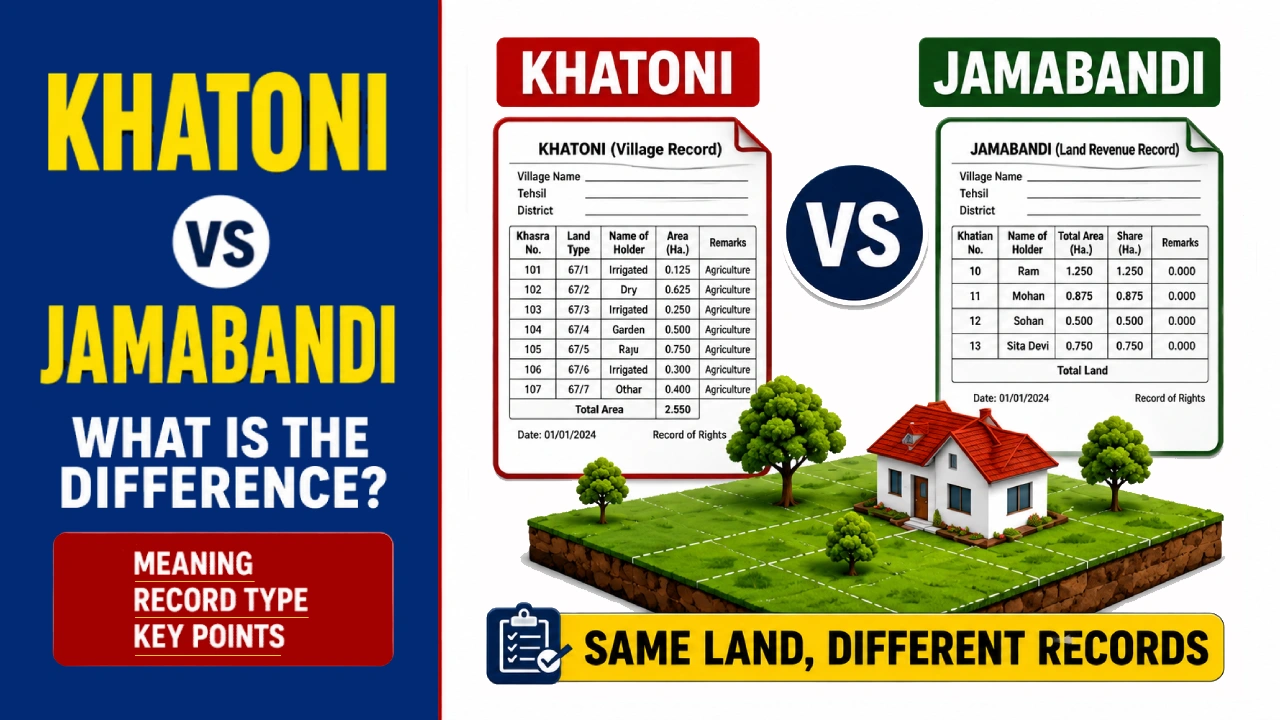
Whenever you buy a piece of land, a farm, or a plot, you will often hear words like Khatauni and Jamabandi from revenue officials, local authorities, or lawyers. For a common person, these two words sound exactly the same. People often get confused about whether they need a Khatauni or a Jamabandi to prove their property ownership.
The land record system in India is quite old. Because of this, the names and rules for these records change from state to state. In this article, we will explain the differences between Khatauni and Jamabandi in very simple language, and show how you can easily check them online from home.
Quick Definitions
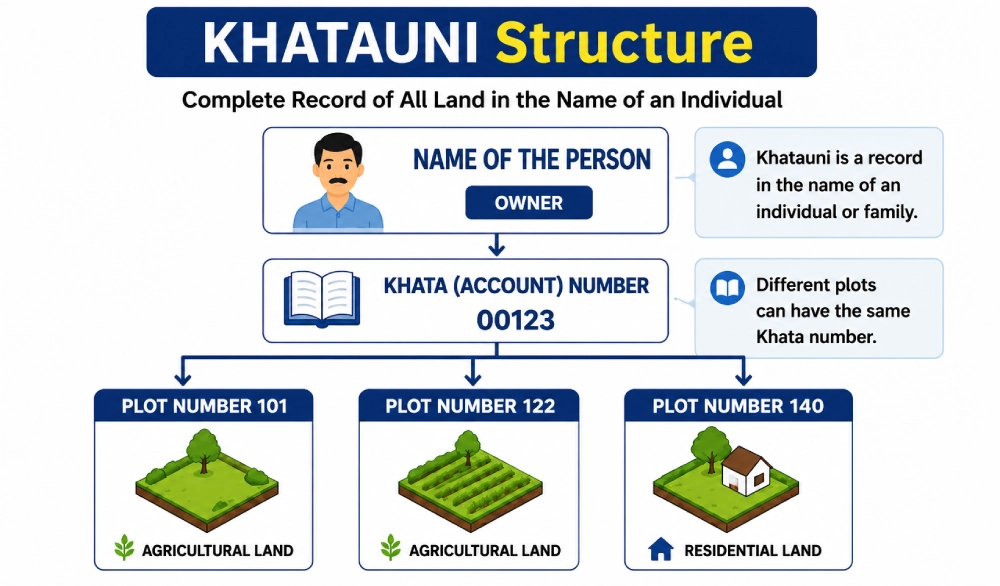
Khatauni: A land record document that lists all the pieces of land owned by a specific person or family in a village.
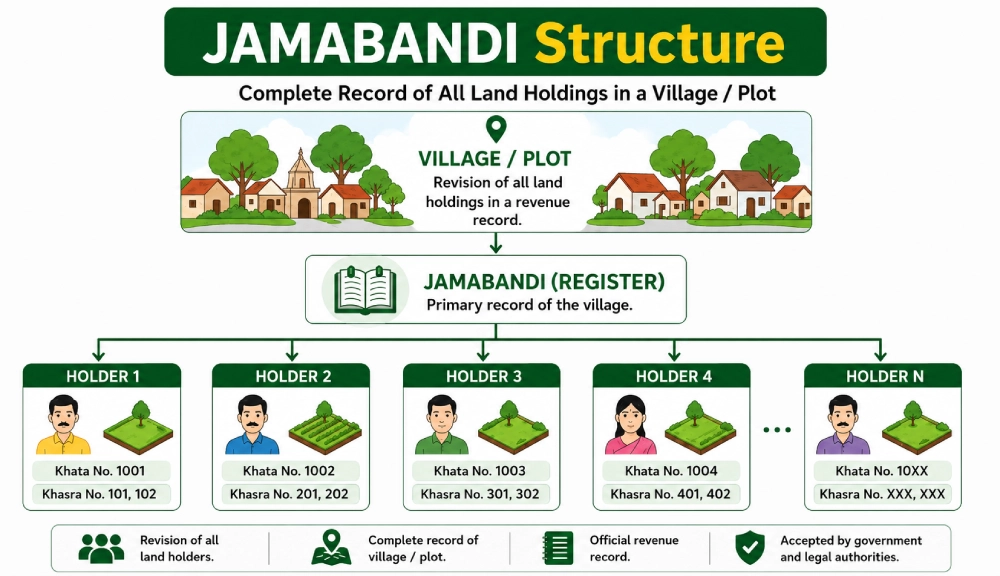
Jamabandi: A master land register for an entire village that tracks land ownership, cultivation details, and land revenue tax.
Which Land Record Applies to Your State?
Depending on where your property is located, you will need to check a different document:
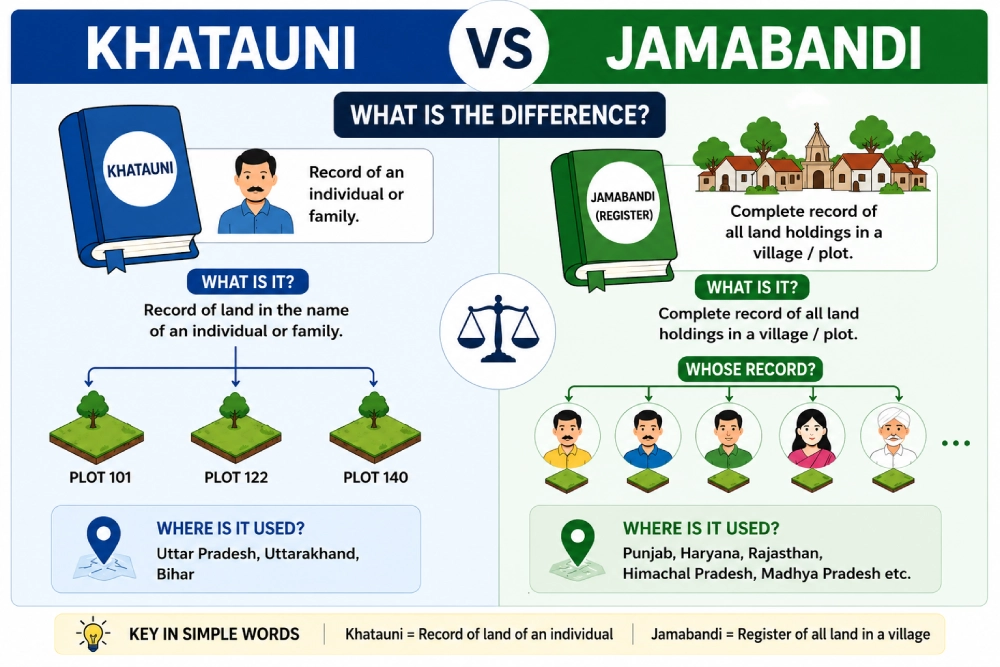
If your land is in Uttar Pradesh, Uttarakhand, or Bihar, you need to check the Khatauni.
If your land is in Punjab, Haryana, Rajasthan, Himachal Pradesh, or Madhya Pradesh, you need to check the Jamabandi (also popularly called Fard).
What is Khatauni?
Think of Khatauni as a property “report card” or an account statement for a specific person or family. For example, if you own three different small farms at different corners of a village, each farm will have its own unique plot number (Khasra number). Instead of creating separate documents for each farm, the government opens a single property account in your name. This account is called your Khatauni. It lists every single plot or piece of land you own in that village in one single place.
What Details Are Found in a Khatauni?
A properly updated Khatauni document contains the following important details:
- Account Number (Khata Number): A unique number given to your family or individual property account.
- Owner’s Details: Full name of the landowner (or co-owners), parent or spouse’s names, and their residential address.
- Plot Number (Khasra Number): The specific survey or plot numbers belonging to that person.
- Total Area (Rakba): The exact measurement of the land for each plot number. If you want to learn more about how land is measured, you can read our guide on “What is Rakba?“.
- Land Category: The type of land (for example, land that the owner has full rights to sell, or government lease land).
- Land Revenue Tax: The annual land tax that the owner needs to pay to the state government.
- Remarks Column (Orders): This is the most critical part of a Khatauni. If there is an active bank loan on the land, an ongoing court dispute, or if a portion of the land was recently sold, all those updates are written right here.
When and How Does a Khatauni Change?
In the past, land records were revised and updated by local officials manually every 6 years. During those 6 years, if any land was sold or any bank loan was taken, officials would manually write it down in the remarks column.
The New Real-Time Khatauni Rule: Thanks to digital systems, states like Uttar Pradesh and Maharashtra have started Real-Time Khatauni records. The biggest benefit is that you no longer have to wait years for your records to update. As soon as a property transfer or mutation (Dakhil-Kharij) order is approved by local authorities, it is updated online instantly using automated software. This has drastically reduced the risk of land fraud and double-selling.
What is Jamabandi?
While a Khatauni is like an individual property “passbook,” a Jamabandi is the master land ledger for the entire village. The term Jamabandi is mostly used in North-Western and Central India. In states like Punjab, Haryana, and Rajasthan, people commonly call a copy of this official record a Fard. It is a legal document that maps out the entire village land, showing exactly who owns which plot, who is farming the land (the cultivator), and how much land tax is being collected by the government.
What Details Are Found in a Jamabandi?
A Jamabandi register has a wide format with multiple columns. It generally contains the following information:
- Khewat Number: This is the account number for the property owners. If a piece of land is shared by multiple family members, they will all share the same Khewat number.
- Khatauni Number: Note that there is also a “Khatauni number” written inside a Jamabandi register. In this context, it simply tracks who is actively farming the land (whether it is the owner themselves or a tenant/renter).
- Owner and Cultivator Details: Clearly lists the names of the real legal owners and the people growing crops on the land.
- Irrigation Sources: Notes how the land gets its water supply (like wells, canals, tube wells, or rainwater).
- Crop Details: Records the types of crops typically grown on the land during different seasons (Rabi and Kharif).
When and How Does a Jamabandi Change?
A Jamabandi is officially revised and updated every 5 years. In Punjab, Haryana, and Rajasthan, this 5-year revision process is locally called Chausala. The local land officer compiles all property sales, registrations, and mutations that happened over those 5 years to build a clean, updated register. One copy is kept safely in the district record room, and another copy stays with the local land official.
Difference Between Khatauni and Jamabandi
| Feature | Khatauni | Jamabandi |
| Basic Concept | It is a summary of all land holdings owned by a specific person or family. | It is the master register for an entire village tracking ownership, tax, and farming. |
| Main States | Uttar Pradesh, Uttarakhand, Bihar. | Punjab, Haryana, Rajasthan, Madhya Pradesh, Himachal Pradesh. |
| Update Cycle | Traditionally revised every 6 years (now moving online in real-time). | Revised every 5 years (known as Chausala). |
| How to Search Online | Can be easily searched online using the owner’s name. | Usually requires a specific Khewat or plot (Khasra) number to search. |
| Loans and Disputes | Unpaid bank loans or active court cases are shown in the “Orders/Remarks” column. | Active loans are recorded under the land records as a mortgage (Rahan). |
Why You Must Check These Records Before Buying Land
If you plan to buy a new piece of land or a plot, checking these records is your best safety shield against fraud:
- Confirming the Real Owner: Before signing any paperwork, ask the seller for a fresh copy of the Khatauni or Jamabandi (Fard) depending on the state. Check online to verify if the seller’s name matches the official government records perfectly.
- Important: Do not buy land based only on a Khatauni or Jamabandi. Always verify the registered Sale Deed (Registry), total area measurements, local circle rates, and land type before making a deal.
- Finding Hidden Co-owners: Many properties in India are owned jointly by a family. Checking the Khatauni or Jamabandi will tell you if the seller’s brothers or other relatives also share rights to that plot number. Never buy a joint property unless all co-owners give their written consent and sign the deal.
- Checking for Unpaid Loans: If the owner took out a bank loan (like a tractor loan or a Kisan Credit Card loan) against the land, it will be noted in the remarks or mortgage section. Buying land with an outstanding loan can bring severe legal trouble unless the seller clears the dues and gets a ‘No Dues Certificate’ from the bank first.
How to Check Your Khatauni and Jamabandi Online
The days of making endless trips to government offices just to get a copy of your land records are gone. Under the Digital India program, almost all states have moved their land records online. You can check your complete land details on your smartphone or computer within a few minutes by visiting your state’s official Bhulekh website.
Which Printed Copy is Valid for Official Work?
A standard, free printout taken from the internet is not accepted for official or legal work. If you are submitting paperwork for a bank loan, a court case, or property registration, you will need an official Digitally Signed Copy or a certified copy carrying an official stamp from the local authority office.
Expert Advice: When buying land, do not rely blindly on a free internet printout. Always request a digitally signed copy for official verification. Furthermore, as soon as your property registration (Sale Deed) is complete, apply for Land Mutation (Dakhil-Kharij) immediately, because your ownership is not completely safe in government tax records until mutation is finished.
If you have recently purchased a property, make sure you understand the key differences between a Registry and land Mutation.
Frequently Asked Questions (FAQ)
Should I check Khatauni or Jamabandi for my land?
It depends entirely on the state where your land is located. If your land is in Uttar Pradesh, Uttarakhand, or Bihar, you must check the Khatauni. If your land is in Punjab, Haryana, Rajasthan, Himachal Pradesh, or Madhya Pradesh, you must check the Jamabandi. Both documents serve the same purpose: showing who owns the land.
How can I correct a spelling mistake in my Khatauni or Jamabandi?
You do not need to worry or run around for a long court case. Take a copy of your registered Sale Deed to your local revenue office (Tehsil) and submit a simple application for a Correction of Record in the local revenue court. It can be fixed easily.
Are free online copies of land records valid for bank loans or court cases?
No, free online copies downloaded directly from the internet are only for informational purposes. For official needs like a bank loan, court case, or selling a property, you must provide a Digitally Signed Copy or a certified copy stamped by local authorities.
Can multiple people have their names on the same Khatauni or Jamabandi account?
Yes, this is known as a Joint Account. This is common with ancestral land that has not been officially divided among family members or siblings. When buying such land, it is mandatory to get the written consent and signatures of all co-owners listed in the record.
What is the difference between Jamabandi and Fard?
Legally, there is no difference; they refer to the same record. The master register kept by local authorities is called the ‘Jamabandi’. When a landowner gets an official printout or a certified copy of their specific record from that register, that printed copy is commonly called a Fard.
Conclusion
To sum it up, Khatauni and Jamabandi are simply two different ways of looking at land records. A Khatauni shows all the pieces of land owned by a single individual or family, while a Jamabandi acts as a master register for an entire village. No matter which state you are buying land in, make sure to check whichever document applies to your area thoroughly. When investing in real estate, being careful is your best protection-always trust official public records over words of a middleman to keep your investment safe.
Disclaimer: Property rules and land terminology change across different Indian states. Always check the latest guidelines with your local land records office or consult a professional property expert before making a final transaction.

Neha Yadav is an engineer and researcher specializing in Indian land records, property documentation, and government land procedures.
At BhumiGyan, she creates well-researched, easy-to-understand guides on topics such as Bhulekh, Jamabandi, property registration, Sale Deeds, Mutation, and other legal property processes, helping readers make informed property decisions with confidence.